Showing posts with label Guest Reviewer Of The Day. Show all posts

16.11.14

Guest Reviewer Of The Day: Way Off Scenter

A landscape architect and garden writer by trade, Way Off Scenter is a long-established and prolific reviewer of fragrances for the Basenotes web site, first as “Vibert” and then as “Off Scenter.” He has been reviewing under his current moniker since returning from a two-year’s absence at Basenotes. Click here for more reviews by Way Off Scenter.

MAAI: A Remembrance of Things Past


MAAI is an enormous, unapologetic animalic chypre scent composed in a style that hearkens back to the tropes of post-WWII perfumery. Perfumers like Edmond Roudnitska, Germaine Cellier, and Ernest Daltroff used to compose scents of this ilk for such firms as Hermès, Piguet, and Caron. Now MAAI stands as a glorious anomaly and a tribute to an art of classical perfumery that seems at times to be languishing.

Imagine, if you will, Cellier’s Fracas bedding down with Opium and Serge Lutens’s Muscs Koublaï Khan on a mattress filled with oakmoss (real, I’m told!) and you’ll have some sense of MAAI’s overall structure. The composition feels like three massive blocks laid down over a chypre foundation. First to emerge is a pungent animalic component (the Muscs Koublaï Khan part), rife with civet and castoreum, and not all that far removed from the animalic accords in Roudnitska’s original Madame Rochas or Daltroff’s vintage Narcisse Noir. Next up is a sensuous tuberose-centered white flower accord, smoother and quieter than Fracas, but still decadently creamy and substantial. Last out of the starting gate is an intensely spicy amber oriental, seasoned with cinnamon, cardamom, bergamot, and plenty of labdanum. (Opium, anybody?) The two last-mentioned notes blend with the potent oakmoss to establish MAAI’s profoundly rich chypre accord. The result is simply magnificent, and seems certain to cruise to the head of my “Best Release of 2014” list. (Not that there’s much competition.)

Once the elaborate tripartite structure is established, the components slowly rotate through olfactory space, yielding an ever-shifting sequence fragrance perspectives. Projection and sillage are both copious, especially for the first four to six hours of wear. After that, MAAI very slowly distills itself down to a marvelously warm and decadent labdanum and oakmoss skin scent, in a drydown that remains detectable for at least a day after application. Though the description might put some men off – what with that tuberose – MAAI strikes me as a thoroughly unisex composition. In fact, my wife says she has a hard time imagining it on a woman. At any rate, I heartily recommend that anyone with a serious interest in fragrance sample this great big, indulgent and uncompromising chypre. They just don’t make ‘em like this anymore!

Rating: a shocking 9.5-10/10

6.11.14

Guest Reviewer Of The Day: Colin Maillard

Today I've the pleasure to host one of my favorite reviewers of the last couple of years or so: Colin Maillard. Already known and respected by fragrance-freaks for his severe but totally solid perfume criticism on Fragrantica and Basenotes, Colin is actually one of the sweetest guys around. He likes to read and write just like he did when he was 5. He loves his cat, his girlfriend and traditional tattoos but, most of all, he loves his mortgage with which he's bond in a really long-term relationship.

He also runs his personal fragrance-related blog Ye Olde Civet Cat. For more reviews by Colin Maillard please check here and here.

Tiffany For Men: Luxury In A Bottle.

Straight to the point: Tiffany for Men (vintage, "cologne" version) is a masterpiece. Jacques Polge composed it pretty much when he was working on Chanel pour Monsieur, and the similarity between the two fragrances is quite clear, but to me Tiffany overpasses the Chanel to any extent - creativity, richness, uniqueness, class. If you want, in a way this is far more "Chanel" than the actual Chanel. The opening of Tiffany is quite, and I’d say "deceptively" at first, adherent to late 1980's/early 1990’s “modern” trends in masculine perfumery: a chypre accord with sweet and powdery nuances, that is classic masculine structures revisited with a dandier, more exotic and more feminine touch. The soft, mellow, sweet notes of the Nineties are around the corner. In a way, the opening is also a bit similar to Héritage by Guerlain, mostly for its complex spicy-woody-floral substance, but only in this very first phase, and anyway in a far more compelling and balanced way here. The initial accords are all about powder, woods, oak moss, dense humid flowers (rose, carnation) and spices, quite "heavy" in a way, but wait just a bunch of minutes for heaven's door to open. 

Not more than thirty minutes after application the scent literally opens, or in a more figurative way, "blossoms up" with an airy, spacious, dimensional power which I have almost never experienced in perfumes - and that surely is the first significant mark of difference with the abovementioned scents this one is often compared to. Partially this would be probably due to the extremely high quality of materials, as this scent dates back when brands still destined high budgets to perfumes (especially a discreet and sophisticated brand like Tiffany about to launch their first perfume for men); and partially to the talent of Polge in using and balancing them. Once the opening phase passes, everything starts to smell more and more sumptuous, golden, invigorating, extremely refined , with a palpable yet oniric feel of silk, warmth and elegance, with just a hint of shady animalicness on the very base. The magnetic, irresistible smell of pure luxury - Clive Christian, Roja Dove, Amouage? Parvenus. 


Tiffany for Men is even quite simple to describe as regards of what it actually smells like, as I mentioned above it is basically all about citrus-neroli notes on head, oak moss and rosewood on the base, a really subtle and velvety woody-smoke note all over which creates a great sense of "shady" and sensual refinement, and then this central heavenly symphony of talc, iris, jasmine, rose, carnation, spices, vanilla, sandalwood and amber notes, both the "warm", sweet amber note and something which to me smells like amber gris, the real salty-camphoraceous one (but it may just be benzoin which creates that feeling with woods). All realistic, vibrant, golden, captivating: we're talking about great iris, great rose, great woods, (perhaps) great ambergris... you can imagine how deep, rich and faceted this gem smells. It's exciting how the greatness of this fragrance grows as minutes and hours pass, contrary on most of nowadays' perfumery (niche included), where averagely all happens within the first hour, then it's all about declining power and faint drydowns. Here, the more hours pass, the better it gets, with a transition towards a dusty woody-iris drydown with a stout oak moss base still dusted with talc, spices and vanilla notes. Which lasts for hours. Tiffany for Men is possibly one of the most rich and refined fragrances for men ever made, and probably (not to sound presumptuous) one of those which are more likely to be loved by people who love perfumes - like those obscure musicians which are praised by colleagues far more than by the audience. Self-confident, restrained just enough, modern and incredibly classy, with just the right amount of dark exoticism yet completely civilized and safe. Finally, one of the very few scents which embodies and expresses my concept of "exclusivity" *solely* by olfactory means (this means neither by price, nor marketing bollocks: just for how great and holy-grail-esque it actually smells).


10/10

15.10.14

Guest Reviewer Of The Day: Claire Vukcevic aka ClaireV.


Claire Vukcevic is a part-time blogger on the blog Fragrancedaily.com and member of Basenotes (ClaireV). She spends money she doesn’t have on perfumes and then writes novel-length reviews of them. But she can’t help it. 

For other reviews by Claire Vukcevic you might want to check Basenotes or Fragrance Daily


Chypre Palatin by Parfums MDCI - Palatial Chypre

I am a big Henry James fan. Or at least I used to be until one day at school, my fifth form English Lit teacher pulled a copy of The Golden Bowl out of my school bag and gasped, “You’re reading this? Oh dear me, no – this is far too difficult for you. It will put you off James for life.” But I had already read The Golden Bowl. In fact, I had waltzed through it, not realizing that it was supposed to be difficult. But do you know what? From that day forward, I have struggled with Henry James. Once someone points out that something is difficult or complex, it becomes so. Like someone flipping that switch in your brain between unthinking enjoyment and sudden, painful self-awareness.

I love Chypre Palatin with my unthinking part of my brain. I know, on a purely intellectual level, that it is a Henry James type of scent – grand, complex, full of moving parts clicking into place. The notes list on Basenotes alone contains twenty separate notes, about two thirds of which I can’t pick up at all. It doesn’t matter. I slip into Chypre Palatin with a shiver of unadulterated pleasure every time, just as easily as my unthinking brain once slid into Henry James. 

Chypres are not usually so easy for me – there is something about them that require me to switch the analysis part of my brain on. Something about the bristling bergamot beginning and the bitter backbone of mosses has always called to mind that scene in Titantic where Rose sees a mother is tapping her six-year old daughter on the spine to get her to straighten up. I admire the formality of chypres, and their immensely ordered, complex structure, but I find it difficult to breathe easily within their confines. 


But Chypre Palatin, I am beginning to understand, is one of those strange hybrids between
chypre and oriental that manage to combine the grandeur of the former with the comfortable, sweet, oozing sensuality of the latter. A soft landing for the bitter Chypre DNA, so to speak. Chypre Palatin belongs, therefore, to a special group of perfumes that includes Puredistance M, Jubilation 25, Une Rose Chypree, and even Guerlain’s masterpiece, Vol de Nuit. What these perfumes have in common is a chypre-like dressing of moss and bergamot, and maybe some other green, bitter, or herbal accents (usually up top), but combined with a base that feels utterly oriental, so that the fragrance starts its journey in an upright position and ends it in a supine position on a soft divan covered with furs and minks in a Sultan’s harem. These chypre-oriental hybrids are massively built, bristling with ambition, and big enough feet to stand in (and tower over) several genres at once – chypre, oriental, leather, animalics, and so on. They are not so much unisex as they are omni-sex. 


Chypre Palatin, for example, has a brief bergamot beginning, like a blush of first light over
the horizon at dawn, and a heart of authentic oakmoss that goes on forever, but these accents are married to a lush vanilla and a warmly animalic castoreum in the base, ensuring that the whole thing feels comfortably sensual. It is very masculine in feel, like Puredistance M, but the vanilla and castoreum in the base make it so cozy and sensual that I really can’t imagine its testosterone-fueled heart would put any woman off. It feels grand, dusty, old-school, reassuringly masculine, and solid. 

Chypre Palatin strikes me as a modern-day Vol de Nuit, in a way. Not in terms of smell, but for the fact that they are both grand, baroque-scaled perfumes recalling a more romantic past than the time in which they were created. Also, despite all of that ambitious scale and reach, they both feel perfectly intimate and suitable for quiet, homebound pleasures. Chypre Palatin might be the Golden Bowl of its genre, but I enjoy it in that simple, instinctive way I used to enjoy Henry James before the thinking part of my brain was switched on. Just don’t listen to anyone who tells you it is a difficult or complex thing.

Rating: 9/10


10.12.13

Guest Reviewer Of The Day: Freddie Jones aka Hilaire.


Driven into the life of a perfume obsessive by the discontinuation of his favourite perfume (Le Feu d'Issey if you're wondering), Freddie Jones is an artist, creative, fashion blogger and youtube perfume reviewer with a unique take on the aesthetics of scent who takes time out of his busy schedule of sniffing things and judging what people are wearing to also work as a consultant in Dublin's only niche perfumery.

Freddie runs a fragrance-related YouTube Channel. Check it out at - http://www.youtube.com/user/fyhilaire
...and a fashion blog http://fyhilaire.tumblr.com/

Parfums MDCI Cuir Garamante - A Cuir by Any Other Name.

If you have ever been to Tunis you'll know what I'm about to say is true. If you haven't been, then go! It's amazing. It combines the charm of an ancient Islamic Casbah with totally authentic souks and bazaars, wonderful mosques, plenty of princely and mercantile palaces from various eras, with a slightly shabby late twentieth century attempt at modernity which is delightful. Around it are rather plush suburbs too, especially around the ruins of Carthage which are essentially like a neighbourhood park to the large and expensive family homes around it. Tunisia is akin to Libya and Algeria in having both a Mediterranean aspect, an Arabic cultural milieu, and a distinctly African flavour. They are all three a mix of the relict influences of their ancestral indigenous culture and the waves of influences which have broken over them. Egypt and Morocco at either end have more distinct and discrete cultures. They act as bookends. Tunis and Tripoli in Libya share an inheritance of Andalusian culture. The expelled Moors of Spain brought back their hybrid culture to North Africa with them and it flourished in these already heterogeneous coastal entrepot.

Among other things Cuisine, Leather working (an Andalusian Moorish speciality) and Perfumery (brought to a high degree of sophistication in early medieval Spain by Muslim rulers who found themselves in a comparatively lush country capable of producing large harvests of fragrant flowers unlike their Sahel Urheimat) were all given new vigor in North Africa by this population reabsorption from Iberia.

A visit to Tunis, as I imagine is the case with Tripoli or Benghazi cannot be complete without
a thorough wandering through its perfume markets. Among the myriads of ugly fakes and cheap knockoffs you do still find pockets of more traditional authenticity. We came upon a shop where they made rosewater and orangeflower water out back in large stills and where decent quality attars could be obtained if you had the patience to haggle for extended periods of time. The smell of the place itself was intoxicating. It was hot ( I mean Sahara hot) so the stones of the medieval buildings were giving off their terracotta/adobe smell that hot rocks sometimes do, and dust and parchedness undercut everything. Huge bales the size of cars full of rose buds and orangeflowers gave off waves of thrumming sweetness and the smells of leather being worked in nearby artisanal workshops added to the melange. In fact so cheek by jowl are these kinds of establishment that leather products from the one and perfumery from the other smell of one another inextricably. The satchel I bought in Tunis smells of roses and hot dust almost more than it does of leather. 

Its a smell I will never forget. And it's exactly what Cuir Garamante smells like. Yes there are hints of plum and dates (doubtless a side effect of one or other rose synthetic) and there is incense too, mostly supplied by Labdanum (another Iberian echo), and there is even a goodly dollop of sweaty funkiness in there too which adds authenticity since wandering the souks of Tunis can mean being crammed together with lots of people in tunnel-like covered streets in high temperatures even at night. But above all this is the recreated alchemy of a complete amalgam of dried Roses and supple tanned hides. There's also more than a nod to Oud Ispahan about this composition though thankfully I don't expect it to be quite so isotopic in its half-life.

Rating: 8.5/10

25.11.13

Guest Reviewer Of The Day: Andrew Rayment


Today's guest is my special friend, hardcore perfumisto and extremely talented writer Andrew Rayment (aka *anydray* on Fragrantica and *only_me* on Basenotes). One of the most inspiring, refreshing and uplifting individuals I met in the fragrance-sphere. I hope you'll enjoy his writing as much as I do.

Masque Milano Terralba: Move on Sel Marin, there's company.


I have always been fascinated by a small area of beach that stretches between a featureless, man-made promontory perpendicular to the coastline, towards the almost militarily, bunker-like, concrete walled curvature that forms the west-facing arm of Brighton’s Marina. Apart from the occasional presence of a few dedicated sea anglers, this appears a mostly uninhabited and redundant area, providing a natural dumping ground as prevailing south-westerly winds wash-up tons of stinky seaweed together with all manner of sea-born detritus on to this pebbled area, the un-trodden borders of which hosting an abundant display of visually unspectacular though nevertheless indubitably hardy beach plants. This is in stark contrast to the typically very busy coastline that extends further west towards and beyond the famous Palace Pier, and where the ‘clean’ pebbled beach provides much enjoyment for walkers, bathers, and water-sports enthusiasts depending, of course, on the time of year and weather conditions. 

Occasionally, here, I have heard the characteristic ‘poo-eep’ call of a pair of ringed plovers that I assume nest nearby in this rather untamed area and, on occasion, I have espied these beautiful birds, in-flight, and then scurrying along the pebbles, only to disappear when they pause, adroitly blending-in to the shingle by way of their natural camouflage. 

Wildlife aside, however, the seduction of this stretch of beach is perhaps, I admit, due the implicit tug of deep literary influence as this space offers a paradigm Ballardian landscape, my limbic area and cortex already hard-wired in anticipation of a disquieting light aircraft buzzing across the sky, or, in making the acquaintance of ‘Vaughn’ or ‘Travis’, the archetypal solitary Ballardian protagonist who has made refuse in this secluded place whilst ruminating on his future role as ‘leader’ in an eco-disaster dystopia. 

To cement this vision further, behind the Marina’s fortress-like walls lies the almost surreal
juxtaposition of expensive yachts and boats moored alongside a higgledy-piggledy assembly of somewhat tawdry 1980s, quasi submerged, buildings including: a large multiplex cinema and huge ‘Asda’ supermarket, both with their shared, gloomy, shadowy, hollow car park, together with a flashy casino, bowling alley, the gym I attend, and a parade of shops, hotels and restaurants, some of which are adorned with ‘stars and stripes’ signs and chevrons presumably to create the appeal of something ‘more American’ for visitors to this small English nautical park of sorts.

Anyway, as with many of my posts, I digress, and Ballardian notions notwithstanding, there is nevertheless something wonderfully bracing and uplifting in being near the beach, here, with all its myriad smells and all its possibilities and, today, when the air is chilled and hats and scarves are required, wearing ‘Terralba’ becomes an absolute delight. 

'Terralba' inhabits the olfactory realms of Heeley’s distinct, ‘neo-aquatic’, ‘Sel Marin’ and Lyn Harris’s majestic achievement, ‘Fleurs de Sel’, as it shares distinct similarities in expression in terms of saline evolution. It is, moreover, almost how I would have liked Creed’s disappointing ‘Erofla’ to unfold as ‘Terralba’ has a gorgeously abundant and utterly uplifting citrus opening that tempers its underlying and emerging saltier ‘marine’ themes, arguably avoiding the fate associated with those abrasive, synthetic, 90s aquatic chords that possess the capacity to insult those neurons passing through one’s cribriform plate. 

Indeed, as with Masque’s delectable, earthy, ‘Montecristo’, there’s something exquisitely sophisticated about this perfume as the Nose, Delphine Thierry, has seasoned the composition to perfection, never over-applying any ingredient and allowing the woody, herbal, and subtle resinous notes to develop aromatically, gently, softly, naturally, and with a sense of warmth that, interestingly, assumes an alluring soft leather expression on my skin. 

This is an exceptional, beautifully composed perfume with fine longevity and, given its magnificent bottle, the explicitly, riveting cap, and beautiful ‘hat-box’, IMHO, ‘Terralba’ is one of THE perfumes of 2013 and, if you enjoy the salty artistry of the respective Miller Harris and Heeley perfumes, then I highly recommend that you try this. 

Rating: 7.5-8/10

18.1.13

Guest Reviewer Of The Day: Drseid

Straying from his “day job” as a small package logistics executive for a large cataloger, drseid loves to combine his two bank account busting passions of high-end audio and collecting fragrances.  While listening to his favorite music on speakers that are nearly as tall as him, he has written over 350 fragrance reviews on Basenotes and parfumo.net the past year alone.


The Wonderful World of Anat Fritz and a Tale of Two Polar Opposite Scents

Having been drawn to this fragrance seeking passion for well over a quarter century, I have sought to get my nose on just about every fragrance and fragrance house of interest, whether they are mass market designers, artisanal niche one “nose” outfits and everything in-between.  Having sniffed well over 450 fragrances of all price ranges and popularities alike the past year alone, it is quite rare that a fragrance let alone an entire fragrance house moves me enough to call specific attention to it.  I am happy to report that the relatively obscure designer house of Anat Fritz is one of those very rare occasions.

I confess that I came upon the house purely by chance, as I saw an announcement for Tzora on a popular fragrance web site and thought the knitted webbed bottle looked rather unique, leading me to seek out more information about the fragrance inside it.  Digging a bit deeper I found the nose behind Tzora was the great Geza Schoen (of Molecule 01 and Clive Christian X for Men fame, among many others) and that piqued my interest further. The published notes of the fragrance were the final motivator, as I am a sucker for ingredients like cassis, clary, bergamot, Peruvian pepper, magnolia, osmanthus, jasmine, cedarwood, vetiver, patchouli, musk and moss.  It was definitely time to get a sample of Tzora from the US distributor LuckyScent to see if it could live up to my high expectations.  So begins my wonderful journey discovering this great house that had slipped under the radar for so many years and the fabulously talented person behind it…

Tzora

Tzora opens with just the faintest whiff of fresh orange before quickly transitioning to a sharp sparkling bergamot and Peruvian pepper tandem that dominates the heart of the scent with a very subtle mossy green undertone. The Peruvian pepper is deftly implemented, never overpowering the other elements but rather meshing with the bergamot in perfect harmony. As the Peruvian pepper slowly recedes, a very fine cedar emerges to take its place, mingling with the still remaining bergamot through the dry-down, adding shimmering vetiver support.  Projection is below average and longevity is excellent, providing well over 11-12 hours at near full strength on skin.


Tzora was a late entrant to the 2012 party (at least in the US), but it captivated me from the get-go and the longer I wear it the more I enjoy it.  It is officially classified as a floral chypre, but I think it is more like a citric/woody scent with spicy and earthy support. Tzora is quite the textbook prototype of executing a composition using minimalist restraint in its implementation; with Geza Schoen showing off all his enormous talent here in what I feel is his best work to date.  Terre d'Hermes fans in particular looking for a fragrance that has a similar vibe but is more polished and less vociferous will most likely find Tzora quite appealing, as while it is no Terre d'Hermes clone at all, it occupies a similar space and beats the great Jean-Claude Ellena masterpiece at its own game (not an easy accomplishment).  To bottom line it, Tzora is the one of the three finest new releases I have smelled in 2012, earning an extremely rare 9.5 star out of 10 rating from me. This one is an absolute masterwork of the highest order and it would not surprise me if it stands the test of time.

Rating: 9.5/10

That brings us to the initial release from the house that started it all…  After being completely wowed by the new release, Tzora, I had to get my hands on a sample of the original release from the Anat Fritz house bearing her namesake (composed by Anat herself).  The published notes on Anat Fritz (original formula) are lavender, vetiver, cedarwood, patchouli, sandalwood.  Let’s take a look at how the original release measures up to the super-high standard of the more recent one composed by Schoen…


Anat Fritz (original formula)

Anat Fritz opens on skin with a fresh strong breeze of aromatic wild lavender that soon joins a very sharp natural cedar and raw grassy vetiver in the heart to create the dominant overall accord running through its relatively linear development. The heart accord is dirtied slightly by the deft use of patchouli in the base coupling with just the faintest hint of relatively dry sandalwood, never calling attention to itself.  Projection is quite strong and longevity is near equally outstanding, lasting between 10 and 12 hours.


Anat Fritz has been pretty thoroughly ignored in the perfume community since its 2006 release, but now having sampled it I am quite disappointed in myself for not giving this a sniff a lot earlier, as it is a perfect fit for my fragrance preferences.  Ms. Fritz earns extra points for utilizing the lavender here (a note I generally dislike) in a way that it complements the sharp cedar perfectly by focusing on its aromatic qualities and spurning its powdery facets frequently featured by most.   Unlike Tzora that is so skillfully restrained and remaining well in the mainstream, the original Anat Fritz is rough and unpolished, earthy, aromatic, powerful and invigorating. Both scents are near equally appealing but in polar opposite ways. The long and the short of it is Anat Fritz is an outstanding "masculine" leaning release that will appeal to cedar, lavender and vetiver lovers who want to make a strong statement, earning a second extremely strong "masterpiece" rating of 10 stars out of 10.


*Please note that the original version of the scent (that is reviewed here) has been re-worked by Anat herself in June of 2012. The new version according to Ms. Fritz tones down the lavender focus, making the scent a more balanced earthy composition.  I have not sniffed the newly re-worked version as yet (as the remaining original bottles are being sold first), so I can only pass on how Anat describes it but having been so thoroughly impressed with her work on the original version I look forward to trying it out shortly when it is available and will update my review with any new impressions if warranted after doing so. 

-------------------------------------
I have now tried the re-worked version of Anat Fritz and it does indeed tone down the aromatic lavender just as Anat mentioned. That said, I don't really get more of an earthy feel to the re-worked fragrance, but rather more of a focus on the natural smelling cedar. The overall composition comes off as a bit more polished, but still keeps a lot of the untamed nature that I loved so much in the original formula the review is based on. I guess the most important question is does this re-work improve on the original? My feeling is it depends on what you are looking for... If you want an absolute rugged and wild edge to your compositions then the original is going to most likely appeal more to you... If you want a *bit* more refinement and less aromatics, especially early then the re-work should be more to your tastes. The main aspects of the original composition are still very much in-tact with the rework, and I personally love both efforts equally. My overall rating remains the same for either version.


Rating: 10/10


Reviews courtesy of Drseid.

5.10.12

Guest Reviewer Of The Day: Diamondflame


Diamondflame was a scholar who gave up a lucrative career in accountancy for a more spiritually enriching one in the healthcare frontline. A self-professed Renaissance man with myriad interests, he is as likely to be found examining the facets of a diamond as he is in a sweaty ring, bareknuckle sparring. He has contributed over 500 reviews on Basenotes and posts regularly on Houzz, an interior design and decorating site. 

“Life is full of beauty. If only one knows where to look...” probably sums up his philosophy towards life. Little surprise fragrance appreciation came right up his alley.


Geoffrey Beene Grey Flannel: Faded, But Not Forgotten.

The opening is brutal - a straight jab to the nose that makes your eyes water with its pungent combination of citrus, petitgrain, clary sage and violet leaf notes. Dark green and unforgivingly bitter, the first few minutes will have you gasping in a chokehold till the boy in you cries out "uncle!" and taps out. The man however toughs it out till the scent relaxes its iron grip.

The reward? A few great hours of complex olfactory aura that oscillates between soapy clean freshness, subdued green florals and the earthy dampness of mossy undergrowth. There is a certain underlying warmth, somewhat coumarinic in feel, holding the elements together by lending a touch of roundness to what could have been a highly angular composition. No doubt the ingredients are synthetic but the brilliant composition more than made up for it; Grey Flannel smells far better than it has any right to be, almost like an expensive niche or bespoke. Suave and rather distinguished, this masculine aromatic floral punches well above its weight.

Grey Flannel fits elegantly like a well cut suit and offers no apologies for its sharply tailored virility. It bears none of the friendly opening notes that buyers, especially the younger ones, love in modern top-loaded fragrances. Since 1976 it continues to sport the utilitarian looks of a supermarket housebrand with its non-descript deep green glass bottle.

In a field populated by calone bombs, sugary confections and cotton candies, Grey Flannel's shadowy green profile is the bitter shot of absinthe that distinguishes the men from the boys. Now that the average attention span of consumers has shrunk to that of three year-olds, Grey Flannel will likely remain a hidden gem, known only to the initiated few with discerning tastes. I pray it remains so, faded perhaps but never forgotten.

Notes:
lemon, galbanum, petitgrain, violet leaf, clary sage, rose, geranium, cedar, oakmoss, tonka bean

Quality *****
Wearability ***
Projection/Sillage ****
Longevity ****
Value for money *****
Overall Rating: 9/10

Review courtesy of Diamondflame.

12.8.12

Guest Reviewer Of The Day: Sugandaraja (Pt.2)

Today we go with the second contribution by one of my favourite perfumistos around: Mr Sugandaraja. For further informations on the author you migh want to check his previous article here.

Sugandaraja's new gift to Ner Profumo is

Cuir Ottoman: Iris With A Leather Fetish


I'm of the school of thought that when it comes to irises, there are two kinds: Iris Silver Mist, and everything else. Leaving his rooty majesty aside, the soft powdery accord familiar in a hundred fragrances ( and to a hundred-thousand noses through releases like Dior Homme ) is here tooled into the form of a blooming iris that's suede to the touch.


While, from what I understand, Parfum d'Empire was dragging out some hoary orientalist association with the late Turkish empire ( "Ottoman Leather" ), my English mind can't help but keep the word order intact and read it as a Leather Ottoman in the sense of being a small, upholstered foot-rest ( ottoman's other English meaning ), which it aptly resembles in mellowness. I can easily picture myself in full Romantic pipe-dream repose, feet up on an ottoman, smelling of Cuir Ottoman, and listening to a languorous work like this one.


In esse, that's what Cuir Ottoman is about for me: comfort. Leather is typically either a challenging note, or more commonly, not leather at all. Here a true new-shoe leather is supported by an enormous violet-iris accord ( placed between orris butter and violet candy ), a smooth balsamic facet, and a dark, fleshy jasmine that stays well in the background. No notes ever appear or disappear to my nose, its richness compensating for the static development. Throughout it has a certain chilled vaporous quality somewhere between Sarrasins and Caron's Pois de Senteur.


I'm not usually one to venture into the much vexed-about topic of fragrance and gender, but I will say this: if Cuir Ottoman was human, it would be Emma Peel in the leather cat suit, I'm quite sure. Take that as you will.

Rating: 8.5/10

Review courtesy of Sugandaraja. For other reviews by Sugandaraja click here

22.7.12

Guest Reviewer Of The Day: JTD

It is with my immense pleasure that I introduce you, one of my favorite perfumistos and writers ever: JTD

JTD is a perfume blogger who is looking for a new discussion of perfume's subjectivity, considering both the juice and the the wearer as the subjects.  He posts at Frgrantica, Basenotes and Profumo.  He's a guest nose at katiepuckriksmells.com.
JTD's gift to Nero Profumo is a great excursus into masculine chypres...
The Masculine Chypres
The crossroads of the masculine chypre, where the chypre meets the traditionally male virtues of perfumery doesn't create anything revolutionary but it does give us some brilliant and eminently wearable perfumes. Here's how it works.  The chypre is a genre defined by structure: bergamot, cistus, oakmoss.   It's the organic chemistry of perfumery:  a staggering number of possibilities, an enormous range of outcomes.  Masculines fragrances (fragrances made for and marketed to men) are a genre defined by sensibility, specifically timidity. Masculine perfumes are generally Less Than.  Perfumer Bernard Chant, known for having created two of the most bad-assed chypres in history, Grès Cabochard and Clinique Aromatics Elixir, describes the tendency.  “Men, for a long time, have been afraid to use something too different.  They will accept only small departures, small new steps.”[1] Broad strokes here, but fragrances for men are typically diminished versions of women's perfumes, whether in concept, composition or both. An unintended consequence though is that in a thoughtfully considered masculine chypre, Less Than can also mean deliberation, nuance and careful editing.
Take the implicit chiaroscuro of the chypre--its ability to hold opposing ideas in check without blurring or blending. Ask it to speak more conversationally than the dramatic, loud feminine chypres (eg. Estee Lauder's Azuree, Scherrer's Scherrer, Miss Dior.)  The result is nuanced fragrances that center on juxtaposition but not outright conflict. Carthusia Numero Uno (sharp but smooth.) Guerlain's Coriolan (handsome and pretty.) Hermes's Equipage (cozy but aloof.)  Perhaps the best examples of this 'taming' effect can be seen in the Lauder men's/women's versions of the same fragrance. Aramis 900 , an herbal, rose chypre is a quieter, scaled-back version of Clinique's Aromatic Elixir. Similarly, Aramis's Devin is a smoother, less jagged take on Lauder's Alliage.  In most cases, diminishing a fragrance to make it palatable to a masculine ego would make me cynical, but I'm upbeat about these chypres. They seem more tailored than butchered. The tailoring imparts a quiet richness that doesn't so much say manly as gentlemanly.  
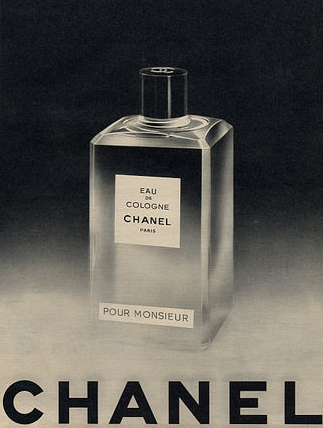
At the top of the chypre heap has always been Chanel's Pour Monsieur. It's held out as the most calibrated, least adorned chypre.  Bright but shadowy, citrus/mossy at the start, ambery/sweet and warm later in the day.  It reads as strong in that it has a bold, simple overall shape but it has minimal sillage and therefore doesn't seem forceful.  It's the pitch-perfect hybrid of the clarity of the chypre and the intentionally short reach of the masculine.  My only problem with Pour Monsieur is it appears to have suffered at the hands of IFRA-induced reformulation.  It seems faded. It's like the eau de cologne version of an extrait. At its best it comes off as a tease.
There are plenty of other great men’s chypres available.  De Nicolai’s New York bridges the chypre and oriental genres, winding up with the best of each.  [Caveat: I’ve just smelled a current bottle, a whispy orange cologne.  If it is a true example of the current NY, it is a fatal reformulation.] Aramis by Aramis and Caron’s Yatagan match a chypre base to bold elements like leather, woods and herbs.  Etro has the quietly odd yet endearing Palais Jamais, a rubbery, smoky chypre that uses birch tar and bergamot to conjure Earl Grey tea.  The cologne-style chypres for men, similar in construction to Chanel pour Monsieur, tend to find an easy balance of the two genres: bright and citrusy (cologne) and skin-scent muskiness (chypre).  This appears to have been an ideal of the French mid-20th century masculines, evidenced by Monsieur de Givenchy, Eau d’Hermès and the underestimated Rochas Moustche.  All three have a more contemporary English counterpart, Miller Harris’s Terre de Bois, which could be seen as a nouveau chypre with a vetiver base.
And then there’s Lancome's Sagamore. My current favorite men's chypre. Lavender gives Sagamore a sort of fougère camouflage that it sheds early in the topnotes. After that it shows the best of the masculine/chypre hybrid. It balances glassy sharpness with quiet. It's distinguished and identifiable, but keeps very close to the skin.  It has a sharp floral-herbal edge that gives a cool soapiness. Sagamore shows a complexity, an armful notes of fairly equal intensity and density. It's not muddled, it's complex and deliberate. Its winning quality is an unfussy ambiguity. It was reissued as the only masculine in Lancome's La Collection line.  Where Pour Monsieur's lightness is the unfortunate result of reformulation, Sagamore's quiet is intentional and suits the cool, crystalline quality. Sagamore is the anti-dandy and exemplifies the best of the classic gentlemanly chypres.  For the man who wants to wear an exquisite fragrance while still following the masculine maxims of discretion/valor and speak softly/big stick, try Sagamore.  It’s discontinued but still available if you search.
It’s as if a backdoor was written into male gender software and the masculine chypre is accepted along with the worst of the blanched aquatics, loud/bland aromatic fougère and limp woodies. However it’s avoided the gender censor, the masculine chypre lineage has managed to survive to the present and proves that masculine fragrance has more to add to the world than fresh, sport and cool.
by JTD 2012
----------------------------------------------
[1] Bernard Chant, The Challenge of Creativity (a lecture given to the British Society of Perfumers11/11/82)

13.6.12

Guest Reviewer Of The Day: Morton Wilson (aka Mr.Reasonable)


Today's guest is composer / producer (and fume-head) Morton Wilson. Originally from New Zealand, lived in Hong Kong 30 years. His main projects include 'The Original 1930's Shanghai Divas Redefined' album with EMI, 'Shanghai Tang Lounge Collection' and other Remix work commissioned for David Bowie, Gorillaz, Robbie Williams etc. Morton contributes to Basenotes as mr. reasonable and follows Grain de Musc, 1000 fragrances, Monsieur Guerlain, Bois de Jasmin, Sorcery of Scent and Nero Profumo blogs.

Mr. Wilson's gift to Nero Profumo is...

Sous le Vent. “And where were you during that long, lost summer?”

There are some that just click. It’s that simple. I’m not sure whether it’s a mix of cues from my past coalescing in this one composition, or just pure serendipity, that has caused a re-interpretation of a perfume made for a raunchy cabaret artiste from 1930’s Paris to catch me so off guard.

The chypre accord was still very much in evidence in the 60’s and early 70’s when I was growing up and I suspect it has somehow impregnated a sense of innocent security on my own subconscious. When I experience that tactile structure of crisp citrus and forest floor oakmoss I slip into a sense of things being okay – as a teenager, meeting my father for a drink overlooking the harbour after his Saturday game of golf, or, even further back, catching a cloud of grown-upness as my mother and her sister headed out for some shopping and a Pimms, leaving us kids to our surfing and sunburn during the school holidays.

Sous le Vent conjures up a mood, a time and a place - bare foot in cool, damp grass, a westerly breeze, and above all, the sun hitting off the languid swell of the ocean on a lazy afternoon. It’s a breezy scent, the pun is inevitable, and once you have felt its cool caress its hard to forget.

The opening is bright, tart even, with a citrus, verbena and galbanum sting that recalls Eau de Guerlain and Philtre d’Amour. For a few seconds this could be a classic citrus Eau de Cologne, but then that notion is dispelled as it unfolds. Lean in very close (if you dare) and ask yourself what is that tough edgy sheen you sense? An almost alchemical mix of oakmoss, aromatic herbs, some clove and the slightest touch of civet (I swear I can detect it hidden in there), gives a ‘no-nonsense’ demeanour to this personality, an echo of Jicky, perhaps? Then, as you take all this in, lean back a little and a gentle floral bouquet opens up and hovers above the proceedings with a seductive ‘take a slow, deep breath’ mood. 

“Keep your distance, no, come closer, look at me, no it’s okay, you can close your eyes.” There is never an apparent cue or clue to what this scent is saying. It keeps you guessing as to its true intent, all the while infusing the air around you with a sense of ‘let it go, relax and enjoy the ride.’ And then you’re caught. Later you may ask yourself what exactly happened there? And you have to revisit it, again and again and again.

It’s not a citrus eau, although it calls the best to mind. It’s not a hale and hearty aromatic, although you can run your hands across the leaves of the herbs and shrubs. It’s not a ballsy chypre, drawing a line in the sand and saying ‘cross if you dare’; perhaps because it lets so much light in - you don’t actually realise you’re ensnared with that balmy breeze blowing through.

The current EDT is surprisingly light structurally – it’s almost as if a conscious decision was made not to let this one really touch the ground. Of course I would love to experience the original from the 30s, which by all accounts has a heft more akin to it’s predecessors from Jacques Guerlain, Mitsouko and Vol de Nuit, but the knowledge that this was once something with some heft (and no doubt a decent slug of oakmoss) doesn’t distract at all from the pure enjoyment of this version. It is my Hong Kong summer staple, perfect when the temperature is 30+c and humidity is soaring – it walks with me, reminding me of a time when things were less complicated, when everything was okay.

And that’s the enigma that is Sous le Vent.

Morton Wilson, June 2012

Rating: 9/10 (Excellent, but not for everyone).